


Bonzo has announced they will reimburse users affected by the exploit, with support from the Hedera Foundation.
Bonzo Lend exploited for $9 million in oracle attack
The Hedera-based decentralized lending platform Bozno Lend was exploited for just over $9 million after an attacker took advantage of a flaw in the project's oracle system. The attacker was able to deposit tokens worth only a few dollars, then manipulate the project's oracle to reflect a dramatically higher price. They then borrowed $6.63 million in USDC and 34.5 million wrapped HBAR (~$2.4 million).
Summer Finance exploited for $6 million, shuts down

Summer Finance, a defi platform that provides "institutional defi vault infrastructure", was exploited for $6 million in an apparent flash loan attack. The attacker used a flash loan to deposit $64.8 million and then withdraw $70.9 million, taking advantage of a price manipulation bug that allowed them to withdraw more than they deposited.
Shortly after the exploit, Summer Finance announced it had "no viable path forward other than to wind down operations". They added, "a meaningful portion of the team's own capital was held in the affected vaults, removing the runway we needed to rebuild."
- "Lazy Summer USDC Vault Exploit Post-Mortem: What Happened and What Comes Next", Summer Finance
- "Sunsetting Summer.fi and the Labs Company", Summer Finance
Dutch Knaken crypto platform collapses with $8 million in customer funds missing

The Dutch cryptocurrency platform Knaken (not to be confused with the American Kraken platform) abruptly went offline in early June, leaving roughly 30,000 customers unable to access their funds. The company was unable to secure a license under the EU's MiCA regulations, which it said forced them to shut down. Though they claimed to be winding down the company in an orderly fashion, they reportedly stopped paying customer withdrawals, and asked customers to stop filing claims.
Dutch prosecutors asked courts to declare the platform bankrupt and install a court-appointed trustee to oversee the process of extracting assets from the company to return to customers, who are missing around €7 million (~$8 million). The request was approved. The country's Fiscal Information and Investigation Service has also opened a criminal investigation into the platform.
Polymarket customers lose $2.97 million, company blames third-party vendor

Polymarket customers have lost around $2.97 million to an attacker who then swapped stolen Polymarket USD (pUSD) to ETH.
Polymarket, a crypto-based prediction markets platform, quickly made an announcement to claim that a third-party vendor had been compromised to allow an attacker to inject a malicious script into the website frontend. Polymarket has said it will refund affected customers.
Users of the SecondFi Cardano wallet lose $2.4 million in series of hacks

Users of the Cardano wallet SecondFi (formerly Yoroi) have lost a cumulative 16 million ADA (~$2.4 million) across three attacks targeting a vulnerability in the project's wallet generation code.
After the attacks commenced, SecondFi "rescued" another 129 million ADA (~$19.4 million) by moving the assets to a third party entity. They announced that an external accounting firm would verify the funds and process user claims.
About a month after the hack, SecondFi announced it would shut down operations.
Taiko bridge exploited

The Taiko bridge, which allows assets to be transferred between the Ethereum mainnet and the Taiko Ethereum layer-2 chain, was exploited for at least $1.7 million before the network was halted, limiting losses. An attacker was able to forge withdrawal requests to appear as though they matched real deposits. Crypto security firm BlockSec said that the attacker may have gained access to a signing key that had been exposed on GitHub.
Highly active MEV bot known as jaredfromsubway.eth drained for $7.7 million
On blockchains like Ethereum, a strategy known as "MEV" (short for "maximal extractable value") allows intermediaries to profit from manipulating the structure of blocks added to the chain — often reordering or "sandwiching" transactions in ways that extract profits. Automated software known as MEV bots make a business out of this strategy, and one of the most active is a bot called jaredfromsubway.eth — likely so named after one-time Subway spokesman and convicted sex offender Jared Fogle because of its strategy of "sandwiching" transactions by placing trades on both sides, causing the original trader to pay more.
On June 20, an attacker used a series of contracts to cause the bot to grant token approvals that were later used to drain 4,427 ETH ($7.7 million). Some of the funds were then laundered through Tornado Cash.
Main Street USD (msUSD) loses its dollar peg

Main Street USD, also known as msUSD, lost its dollar peg and crashed to around $0.25. At points, the token dipped as low as around $0.06. The asset, issued by Main Street Finance, is supposed to be redeemable 1:1 with Circle's USDC stablecoin. It's used as part of a yield strategy that is marketed as "democratizing the options box spread strategy through a stablecoin". Prior to the depeg, there was about $80 million msUSD in circulation.
On June 20, the verification provider Accountable announced that they had "terminated its service agreement with MainStreet, effective immediately. MainStreet was unable to meet our verification standards." The sudden loss of confidence in the token caused the price to plummet as holders rushed to withdraw funds.
Main Street issued a statement, claiming that "Mainstreet remains fully backed" and that "this is an infrastructure and reporting issue, not a solvency issue." However, they noted that "while our portfolio remains fully backed, converting positions into immediate liquidity depends on prevailing market depth and market-maker appetite."
Aztec Connect hacked for a second time in less than a week

Three days after Aztec Labs' deprecated Aztec Connect blockchain bridge was exploited for $2.1 million, the project has been hacked again for the same amount. Aztec Labs confirmed the second exploit, again trying to emphasize that the code was deprecated four years ago.
The hacks are part of a spate of exploits targeting legacy smart contracts belonging to projects including Raydium and DxSale. Although some projects have developed techniques to circumvent the immutable nature of blockchains and allow smart contracts to be upgraded or retired, many legacy contracts cannot be changed or shut down, leaving them vulnerable to attack indefinitely.
Pudgy Penguins shuts down Pudgy Party NFT game after losing millions in less than ten months

The Pudgy Penguins NFT brand announced it would be shutting down its Pudgy Party NFT games less than ten months after its launch. The game was a mobile battle royale game, but built on crypto rails, with NFTs used for in-game items and characters that players could buy and sell. Pudgy Penguins seemed aware that the crypto aspect would be off-putting to many players, telling Decrypt in December 2025 that they were downplaying the crypto side of things "because the world is not ready for NFTs or crypto, or even blockchain en masse yet. But soon, very, very soon, we're going to use Pudgy Party as the glue between Web3 and Web2."
Although Pudgy Penguins CEO Lucas Netz boasted on Twitter in December about "1M+ downloads today. 10M+ downloads soon." he later admitted interest in the game had quickly died off. In a community call to announce the game's shutdown, Netz acknowledged that within months of the launch, there were only 200–300 active players. The project had lost the company millions of dollars, he confessed.
Deprecated project Aztec Connect exploited for $2.1 million
Aztec Connect, an abandoned defi privacy bridge from Aztec Labs, was drained of $2.1 million after an attacker exploited a bug in the project's smart contracts. Although the project was deprecated three years ago, funds remained in the legacy system. "Aztec Labs holds no admin keys or control over the system; it cannot be paused or upgraded by us," the project posted on social media.
The theft is only the latest in a string of attacks targeting vulnerable legacy smart contracts, many of which cannot be deleted, paused, or changed due to blockchains' immutable nature. Raydium and DxSale are two other platforms that have recently suffered losses due to old, insecure code.
Secret bridge exploited for $4.67 million a week before anyone notices

The bridge between the Cosmos-based Secret network and Axelar network was exploited via an infinite mint bug that went unnoticed for a week. An attacker exploited a smart contract in order to mint a large quantity of wrapped Axelar tokens on the Secret network, which they then redeeemed for around $4.67 million.
The exploit, which occurred on June 10, went unnoticed until June 17, when a transaction failed with a message suggesting that more tokens had been bridged out of the Secret network than had been bridged in.
Secret has warned, "If you hold Axelar-bridged saXXX tokens on Secret, please be aware their backing was affected and your funds may be lost."
Raydium users lose $1.34 million after legacy smart contract exploited

An attacker exploited a legacy smart contract that had been used by the Raydium Solana DEX before it was deprecated in 2021. Though the contract was unused, there were still funds in the liquidity pools affected by the vulnerable contract. Using fake LP tokens, the exploiter was able to trick an old smart contract with insufficient validation into allowing them to withdraw assets.
Raydium has said it will compensate users who lost funds in the exploit.
Humanity Protocol loses $36 million to employee laptop compromise

Humanity Protocol, a decentralized identity project that uses palm scans to try to prove that users are human, has suffered a $36 million loss after attackers compromised a laptop belonging to an employee. After the laptop was infected with malware, the malicious code gained root access, then stole seven private keys that were reportedly accidentally stored in a backup. Several of the keys were sufficient to satisfy multisignature requirements, which are intended to prevent private key leaks from allowing attackers to gain control over sensitive infrastructure like bridges. With multisignature wallets, keys are supposed to be stored separately across multiple individuals and devices; however, in this case, attackers only needed to compromise one laptop to gain control over multisig-protected contracts.
With the keys, the attacker stole more than 6 million of Humanity's H token, then used other keys to upgrade a bridge and drain 141 million more tokens. With the bridge access, they also minted 300 million new H tokens. The attacker then quickly swapped the ill-gotten tokens for ETH, causing the H price to plummet by 80–90%.
Humanity Protocol markets itself as a competitor to Sam Altman's World (formerly Worldcoin), a decentralized identity project that aims to use iris scans to prove that users are unique humans. Humanity raised $20 million in 2025 from Pantera Capital and Jump Crypto.
Thief steals remaining 7,200 unsold The Kiss NFTs in digital museum heist

Remember when Austria's otherwise respectable Belvedere Museum sold 10,000 NFTs representing postage-stamp sized sections of Gustav Klimt's The Kiss for like $2,000 a pop? No? Don't worry, I've got you.
Only about a quarter of them ever sold, leaving about 7,200 of them on the digital shelves. That is, until they were stolen (or, as the museum put it, "transferred from the wallet without authorization"). If valued at their sale price the stolen NFTs would be worth €13.32 million (US$15.3 million), though it's hard to argue the thief could've ever sold them for that amount given the museum had failed to do so for several years.
The stolen NFTs were soon made even less appealing to prospective buyers when the museum un-linked the image files from the digital assets, and OpenSea blocked them from trading.
- Hacker stahl dem Belvedere 7200 NFT-Zertifikate von Klimts "Kuss", Der Standard (in German) [archive]
Gravity Bridge drained of $5.4 million

Gravity Bridge, a bridge between the Cosmos and Ethereum blockchains, suffered $5.4 million in losses likely due compromised private keys. The developers of the protocol urged validators to halt while the theft was investigated, and the bridge was indeed halted shortly after. Two weeks after the hack, the Gravity Bridge interface remained unavailable.
DxSale exploited for $7.3 million

DxSale, a project that was popular in 2021 for launching new tokens and creating liquidity pools, suffered a $7.3 million exploit after ownership of a locker contract was transferred to a new address. Nine months later, the contract ownership was repeatedly moved between many new wallets — likely in an attempt to cover tracks — before $7.3 million was taken from old liquidity pools. The stolen assets were then swapped to BNB and routed through bridges and mixers to obscure the trail.
SquidRouterModule, unrelated to Squid Router, exploited for $3.2 million
A third-party Gnosis Safe smart contract called SquidRouterModule was exploited for $3.2 million. The smart contract included a set string that could be passed to identify a "safe" message; however, the string was visible in the public smart contract code and used by an attacker to impersonate Gnosis Safe users and then drain their wallets. 86 wallets had used the module, and lost a combined $3.2 million.
The name led to some confusion due to the similarly named Squid Router, which is not related. It's not clear if the users who installed the module were aware that the two projects were separate.
Polymarket loses $700,000 to private key compromise
Crypto sleuth zachxbt identified that "A Polymarket admin address appears to have been compromised on Polygon", writing that $520,000 had been drained as of the time of his post. The theft ultimately amounted to around $700,000, and Polymarket confirmed that a "wallet used for internal top-up operations" had been compromised. They did not provide further details as to how the compromise happened, though the company's VP of Engineering later said that the private key was six years old and that all private keys would be replaced with a managed key going forward.
RetoSwap users lose $2.7 million to Haveno vulnerability

The RetoSwap decentralized exchange for trading the Monero privacycoin was exploited after an attacker exploited a vulnerability in the Haveno Monero exchange protocol used by the project. Users lost an estimated $2.7 million when their transactions were routed to the attacker's wallet.
Because Monero is a privacycoin, a type of cryptocurrency that obscures transaction details including sender and receiver wallets, it is not feasible to trace the stolen assets.
Largest North American bitcoin ATM operator, Bitcoin Depot, files for bankruptcy

Bitcoin Depot has filed for Chapter 11 bankruptcy. The company operates a fleet of kiosks at retail locations that allow customers to purchase bitcoin with cash. Bitcoin Depot announced in a press release that its 9,700 kiosks – primarily located at gas stations and convenience stores – had already been taken offline.
The company's bankruptcy filing reports between $10 million and $50 million in both assets and liabilities. In a recent financial disclosure, the company had reported a 49% year-over-year reduction in revenue and a net loss of $9.5 million for the year. The company had also suffered a $3.67 million hack in April.
Bitcoin Depot has blamed a challenging state-level regulatory environment for its bankruptcy, pointing to a series of regulatory restrictions and outright bans on crypto ATMs, which are a major conduit for crypto scams. An FBI report on Internet crime in 2024 showed 11,000 reports of fraud involving crypto ATMs – a 99% increase from the prior year. Almost $250 million was reported lost due to such scams, with a majority of it coming from victims over 60 years old. Several states have responded by introducing laws imposing strict compliance requirements or transaction limits on ATM operators, and Indiana and Tennessee have both recently banned the kiosks entirely. Additionally, the company is defending against lawsuits from both Massachusetts and Iowa, which argue that the company uses a misleading pricing structure, knowingly enables crypto scames, and maintains a predatory refund policy.
- "Bitcoin Depot Initiates Voluntary Chapter 11 Process to Facilitate an Orderly Wind-Down and Sale of the Company’s Assets", Bitcoin Depot press release [archive]
- Issue 92, Citation Needed [archive]
- Issue 105, Citation Needed [archive]
- Chapter 11 Voluntary Petition
Verus bridge hacked for $11.6 million

An attacker stole $11.6 million in various crypto assets from the Verus–Ethereum bridge, which allows users to use tokens from the Verus network on the Ethereum chain and vice versa. The attacker then swapped the tokens for ETH, limiting the ability for issuers of more centralized tokens to freeze the stolen assets.
Verus halted the entire Verus network after the exploit was detected in hopes of limiting further damage.
The exploiter later accepted a bounty offer by Verus, returning 4,052 ETH (~$8.5 million) while keeping the remaining ~25% as a "bounty".
THORchain exploited for $10.8 million

The THORchain cross-chain liquidity protocol was exploited for around $10.8 million across several blockchains: Bitcoin, Ethereum, BNB Chain, and Base. The protocol paused trading after observing the suspicious transactions. News of the hack caused the protocol's RUNE token to drop in price by more than 10%.
Transit Finance hacked for $1.88 million

Transit Finance was exploited for $1.88 million after an attacker exploited a "legacy contract" on the TRON blockchain that the project said was deprecated in 2022. "Historical vulnerabilities within it" were exploited, the project explained, allowing the attacker to steal $1.88 million.
Transit was previously exploited in 2022 for $21 million, although around 70% of the stolen assets were later returned.
TAC bridge exploited for $2.8 million

The TAC bridge, which bridges assets from the Ethereum blockchain to the Telegram-linked TON chain, was exploited for $2.8 million. The project paused the bridge and announced they were investigating.
The project has announced they intend to "restor[e] bridge liquidity through a legally structured sale of Foundation's TAC token treasury reserves."
TrustedVolumes suffers $6.7 million exploit

TrustedVolumes, a resolver and market maker used by 1inch and other defi platforms, suffered a $6.7 million exploit after an attacker was able to steal funds without proper validation. The thief then swapped the stolen wETH, USDT, wBTC, and USDC through ChangeNow and converted them to ETH to evade freezes.
Blockchain research firm Blockaid has linked the attacker to a similar exploit in March 2025 that saw $5 million drained from 1inch. This time, 1inch has asserted that although they use TrustedVolumes as a resolver, the exploit did not involve any of their systems.
Ekubo exploited for $1.4 million

The Ekubo automated market maker infrastructure project experienced a $1.4 million theft after attackers were able to take advantage of a smart contract that improperly verified permissions. They stole 17 wBTC ($1.4 million), which they swapped for ETH and laundered via Tornado Cash.
Wasabi Protocol exploited for more than $5 million

The Wasabi Protocol defi derivatives platform has been exploited for more than $5 million across multiple blockchains. The attack has been attributed by blockchain security firms to a compromised admin key, which allowed the attacker to upgrade contracts to steal assets.
Polish Zondacrypto exchange stops processing withdrawals amid possible insolvency

The Polish cryptocurrency exchange Zondacrypto faced complaints that withdrawals were not being processed as far back as December 2025, but the crisis seems to have escalated. CEO Przemysław Kral attempted to assuage insolvency fears by pointing to a cryptocurrency wallet containing around 4,500 BTC (~$330 million) as proof of assets, but he also admitted that the keys to the wallet were known only to the exchange's previous CEO and not transferred during the company's 2021 sale. The former CEO has been missing for four years.
Polish authorities have launched investigations into the apparent collapse. Losses have been estimated at 350 million zł (~$96 million).
Poland's Prime Minister Donald Tusk has also recently accused Zondacrypto of sponsoring conservative and right-wing politicians, including Polish President Karol Nawrocki. Nawrocki has repeatedly vetoed legislation aiming to regulate the crypto sector, describing it as overly burdensome to crypto businesses. Tusk has also alleged that Zondacrypto was funded by the Russian mafia and Russian intelligence services. These allegations are also being investigated by Polish authorities, and one report citing the country's Internal Security Agency claims that the Kremlin-linked Tambovskaya Bratva Russian mafia group took over the exchange as far back as 2018.
- "UOKiK zbada sprawę Zondacrypto. 'Znacznie poważniejsze nieprawidłowości'", Money.pl (in Polish) [archive]
- Polish leader Tusk claims Russia-linked crypto firm backed Nawrocki’s presidential bid", AP News [archive]
- "Powerful Russian mafia 'took control' of crisis-hit Polish firm Zondacrypto", TVP World [archive]
Volo Protocol exploited for $3.5 million, most recovered

The Sui-based Volo Protocol defi yield platform was exploited for around $3.5 million after an attacker targeted three vaults holding wBTC, XAUm (a tokenized gold asset), and the USDC stablecoin.
Volo says they have frozen or recovered all but around $60,000. They have also said they are "prepared to absorb this loss", rather than passing losses along to their users.
Aave faces approximately $200 million in bad debt after Kelp DAO bridge exploit

The Aave defi lending protocol is grappling with anywhere from $177 million to $236 million in bad debt after the Kelp DAO bridge exploiter used Aave to cash out their stolen rsETH. Rather than selling the tokens, the attacker used the rsETH as collateral to borrow wETH, leaving Aave stuck with the huge quantity of unbacked rsETH. Although Kelp and Aave both froze affected markets, the attacker had already cashed out. The attacker borrowed essentially all of the wETH available on the platform, leaving those who'd loaned those tokens unable to withdraw.
Aave maintains a $50 million insurance fund to absorb bad debt. However, this can't cover such a huge shortfall.

RaveDAO accused of pump-and-dump as token crashes 98%

Binance and BitGet have confirmed they are investigating allegations that RaveDAO orchestrate a pump-and-dump to push its RAVE token price from around $0.25 to more than $27 over the past few weeks, before the token price plummeted back down to $0.66. Concerns were first raised by blockchain investigator zachbxt, who called on the exchanges to investigate. He later wrote, "While it's good the exchanges responded, I find it unlikely this activity wasn't spotted internally before I raised it publicly."
RaveDAO describes itself as a "community-driven global rave powerhouse", and sells NFT tickets to rave events.
RaveDAO has denied any responsibility for the recent price movements, but did not address allegations of enormous token concentration with the project's team or large transfers to exchanges around the time of the price jump.
Kelp DAO bridge hacked for $292 million

An attacker stole 116,500 rsETH (restaked ether) from a blockchain bridge run by Kelp DAO. Based on prices at the time of the theft, the stolen tokens would be worth around $292 million — however, the attacker is likely to face challenges selling a quantity of tokens that amounts to 18% of rsETH's circulating supply.
When tokens are bridged from one chain to another, the tokens on the original chain are locked in the bridge smart contract while the token is used on the other chain, preventing its owner from double-spending the asset. With 116,500 locked rsETH now stolen, those using the token on other blockchains are now holding possibly unbacked tokens.
The rush for holders to offload their dubiously backed tokens is likely to worsen contagion throughout defi protocols, where those platforms could be left holding the bag. Some platforms, including Aave, Lido Finance, and Ethena, have paused markets involving rsETH to try to protect themselves.
This hack has set the new record for the largest defi hack in 2026, following the $285 million Drift exploit on April 1.
Rhea Finance exploited for $18.4 million, some recovered

Rhea Finance's lending product was exploited for around $18.4 million after an attacker took advantage of a bug in the platform's slippage protection feature. The stolen assets affected both platform and user funds.
Some of the stolen tokens were returned by the attacker to the protocol, and around $4.35 million USDT were frozen by its issuer, Tether. Altogether, around $10 million was recovered, leaving $8.4 million outstanding.
- RHEA Finance Protocol Incident, Rhea Finance
Russian Grinex exchange halts trading after $13 million+ exploit
The Russian cryptocurrency exchange Grinex has halted trading after disclosing a hack of more than 1 billion rubles (more than $13 million). The exchange has claimed on Telegram that the hack was perpetrated by "foreign special services" they allege were trying to harm Russian financial independence.
According to blockchain intelligence firms TRM Labs and Chainalysis, Grinex is a rebranded version of the Garantex cryptocurrency exchange that was shut down and sanctioned in March 2025. Two of its operators were subsequently criminally charged in the US.
CoW Swap users lose estimated $1.2 million after DNS hijacking

Users who visited the website for the CoW Swap DEX aggregator on April 14 were unknowingly redirected to a malicious website that drained their crypto wallets. An attacker was able to socially engineer CoW Swap's domain registrar, allowing them to redirect visitors to a malicious site for a period of several hours. CoW Swap has estimated that people who used the service during that time lost around $1.2 million.
- "POST MORTEM: Cow.fi Domain Hijack", CoW DAO
Users lose $9.5 million to fake Ledger wallet app on the Apple App Store
After a fake version of the Ledger cryptocurrency wallet app made it onto the normally highly curated Apple App store, customers lost $9.5 million dollars to the malicious product. Believing it was a genuine Ledger product, people entered their seed phrases into the app, then discovered their wallets were immediately drained.
One victim, a musician who goes by G. Love, wrote: "I lost my retirement fund in a hack/Scam when I switched my Ledger over to my new computer and by accident downloaded a malicious ledger app from the Apple store. All my BTC gone in an instant." According to him, he lost 5.9 BTC (~$445,000).
Crypto sleuth zachxbt traced some of the stolen funds through Kucoin, a Chinese cryptocurrency exchange that was recently fined and forced to exit US markets over licensing and anti-money laundering failures. "The three largest victims lost seven figures each," he wrote.
Apple removed the malicious app from their App Store on April 13, six days after it had been added.
Hyperbridge exploited two weeks after April Fools' hack joke
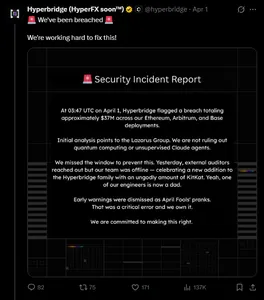
On April Fools' Day, the Hyperbridge blockchain bridge project posted a tweet claiming that the North Korean Lazarus hacking group had drained $37 million from the project. A linked blog post contained a Rickroll GIF and an explanation of "Why Hyperbridge can't be hacked".
The following day, a Hyperbridge developer posted a screenshot of a blockchain transaction, writing "Lmao the uniBTC exploiter is testing Hyperbridge. I hope you have a quantum computer bro". Another commenter replied, "Rule #1 dont actively provoke attackers".
About two weeks later, an attacker was able to forge a transaction to change the admin rights for the Polkadot/Ethereum bridge contract, allowing them to mint 1 billion DOT tokens. They were able to cash out about $2,500,000 due to limited liquidity.
The April Fools' posts have since been deleted.
Bitcoin Depot hacked for $3.67 million
Bitcoin ATM operator Bitcoin Depot has disclosed a March 23 hack in which attackers stole 50.903 BTC (~$3.67 million) from company wallets. According to the company's disclosure with the SEC, the exploiters gained access to the company's IT systems and wallet credentials, allowing them to steal the assets.
Bitcoin Depot is the largest operator of crypto ATMs globally and in the United States, with approximately 8,700 kiosks in the US and 9,200 worldwide.
- SEC Form 8-K filed by Bitcoin Depot Inc. on April 6, 2026
- Top Crypto ATM Operators, Coin ATM Radar
Drift exploited for $285 million

The Solana-based Drift defi perpetual futures exchange was exploited for $285 million. The project alerted the community on social media, writing: "Drift Protocol is experiencing an active attack. ... This is not an April Fools joke."
The project later described the exploit as "a novel attack involving durable nonces, resulting in a rapid takeover of Drift's Security Council administrative powers." Once the attacker had access to admin capabilities, they quickly eliminated risk management limits on the protocol and drained huge quantities of tokens, which they swapped to USDC and then ETH. The attack was attributed to extremely sophisticated social engineering, likely by North Korean hackers.
Some have criticized USDC's issuer, Circle, for not freezing the stolen funds during the six hours they were held in USDC. Unlike ETH, USDC is controlled by a centralized company that can, and regularly does, freeze assets determined to have been stolen or connected to illicit activity.
The theft is among the largest in defi history.
Moonwell faces $1 million governance attack

The Moonwell lending protocol faced a governance attack on its deprecated Moonriver instance that could have drained $1 million from the project. Because Moonwell's MFAM governance token trades at fractions of a cent, an attacker was able to accumulate around 40 million tokens, submit a malicious proposal, and achieve quorum. Moonwell governance token holders scrambled to vote down the proposal before the voting ended on March 27.
Ultimately, facing being outvoted, the attacker dumped their MFAM holdings and the proposal was canceled as their balance had fallen below the proposal threshold.
This was only the most recent of Moonwell's troubles after the protocol suffered a $1.78 million loss in February due to an oracle misconfiguration and a $3.7 million loss in November 2025.
- Attack proposal, Moonwell governance [archive]
- Tweet thread by Blockful [archive]
Balancer Labs shuts down after $110 million hack

After a November 2025 exploit in which $110 million was drained from the Balancer defi protocol, the company behind the project has announced it will shut down. Besides the massive loss, the hack also caused users to flee the protocol, and Balancer's total value locked quickly plummeted from around $775 million to around $300 million. It has continued to decline since, now hovering around $150 million.
Balancer co-founder Fernando Martinelli has said he strongly considered shutting down the protocol entirely, but ultimately decided to continue the project as it generates a relatively small amount of revenue. Instead, the project will move to being operated by a DAO and operating company, which Martinelli hopes will allow them to dodge "real and ongoing legal exposure" and "the liability of past security incidents".
Although another Balancer co-founder has optimistically presented this as "the start of a better chapter" for Balancer, it remains to be seen whether a skeleton crew will be able to revive the project.
USR stablecoin depegs in $24 million exploit

The Resolv USD stablecoin, also known as USR, lost its intended dollar peg and dropped to around $0.14 after an exploiter was able to mint and sell tens of millions of unbacked tokens. USR is an asset-backed stablecoin that uses cryptoassets like bitcoin, ETH, and other stablecoins as collateral.
An exploiter took advantage of a flaw in USR's minting code to create tens of millions of USR tokens without depositing any assets to back them. The attacker then sold the unbacked USR, crashing the stablecoin's price to as low as $0.14. The attacker has profited at least 11,400 ETH (~$24 million), though they are still selling.
Some defi protocols paused USR-exposed strategies to avoid downstream impacts. Resolv issued a statement that the token's collateral pool was unaffected, though this is likely little comfort for those who purchased the unbacked USR.
Venus Protocol accumulates $2.15 million in bad debt after exploit

The BNB Chain's Venus Protocol lending protocol accumulated $2.15 million in bad debt after an exploiter manipulated the price of the Thena protocol's THE token. THE had very low liquidity, and the exploiter took advantage of it to manipulate the THE price oracle by borrowing against THE, using the borrowed funds to buy more THE, and repeating — causing the price oracle to reflect higher and higher prices. The attacker was able to avoid a supply cap on Venus by "donating" the funds rather than depositing them in the standard way.
While the exploit left the Venus Protocol with over $2 million in bad debt, it's not clear if the attacker even made money from the exploit. The exploiter's position was ultimately liquidated, collapsing the increase in THE price. However, it's possible the exploiter took advantage of the price discrepancy elsewhere to profit.
The Venus Protocol has had a number of issues in the past — notably in June 2023, when the team developing the BNB Chain had to intervene when the a thief borrowed $150 million on Venus against stolen tokens and then faced liquidation.
BlockFills goes bankrupt

Approximately a month after halting deposits and withdrawals, citing liquidity issues and "recent market and financial conditions", the American crypto lender BlockFills has filed for bankruptcy. Filings in Delaware bankruptcy court reveal the company has between $50 million and $100 million in assets and between $100 million and $500 million in liabilities. The list of creditors include customers like 007 Capital and Artha Investment Partners, and the firm has a $4.75 million loan outstanding to fellow crypto lender Nexo. Also on the list of creditors are the Chicago Blackhawks, with whom BlockFills signed a sponsorship deal in 2022.
BlockFills was backed by investors including Susquehanna and CME Ventures.
- Chapter 11 Voluntary Petition, Reliz Technology Group Holdings Inc.
Trader loses almost $50 million in Aave swap gone wrong
A trader using the Aave interface attempted to swap $50 million USDT for AAVE. However, due to the enormous size of the order, the purchase had dramatic impact on the aave price. The Aave interface warned the customer about the price impact, and the trader clicked a checkbox to accept the order terms. Ultimately, they received only 324 AAVE (~$37,600) in return for their $50 million, losing 99.9% of their assets in the process.
The Aave founder offered to refund the user the $600,000 in fees collected from the transaction, and acknowledged "there are additional guardrails the industry can build to better protect users".
$26.9 million erroneously liquidated on Aave after Chaos Labs oracle bug
Users of the Aave defi lending protocol who had borrowed from the wstETH/stETH pool suffered erroneous liquidations when a price oracle from Chaos Labs reported an inaccurately low price ratio between the two assets. The oracle bug caused some loans to report that they were below the required "health factor" (the ratio between the assets loaned and the amount of collateral provided by the borrower), triggering forcible liquidations across the platform amounting to $26.9 million.
Chaos Labs, presumably embarrassed to have lived up to its name, promised to reimburse users whose positions were improperly liquidated.
Thief pilfers NFTs priced at $230,000 from Gondi

A thief exploited a smart contract belonging to the Gondi NFT platform to steal 78 NFTs priced at $230,000. Perhaps the most shocking part of the theft is that the attacker managed to find NFTs still holding any value at all. Around half of the stolen NFTs were taken from a single wallet.
According to Gondi, the exploiter took advantage of functionality that allowed users to sell their NFTs to automatically repay loans.
Gondi has said it has reimbursed customers by buying them "comparable items" from the same collections as their stolen NFTs, although it seems questionable that this will satisfy customers who purchased products whose whole selling point is that they aren't interchangeable.
Solv Protocol exploited for $2.7 million

The Solv Protocol bitcoin defi lending and staking platform disclosed an exploit that they said affected fewer than ten users, but nevertheless netted the attacker 38 SolvBTC (a wrapped bitcoin token priced at $2.7 million). Although Solv has not disclosed specifics of the attack, some researchers have suggested it was a bug in the protocol's burn and mint functionality.
Returned crypto stolen again from Korean authorities
After a thief drained a crypto wallet of 4 million PRTG (notionally priced at $4.9 million, but highly illiquid) after blundering Korean tax officials posted the wallet's seed phrase to social media in a photo among other seized items, the thief returned the assets. However, the tokens were quickly stolen again by a second thief, as they'd been returned to the same vulnerable wallet. The first thief turned themselves in and was arrested by Korean law enforcement shortly after taking the funds; the second thief has not been identified.