

The thief's activity began shortly before the Russian invasion of Ukraine. After the invasion, the thief stopped destroying the Bitcoin and instead began transferring it to addresses identified for Ukrainian aid.
Hacker steals Bitcoins from Russia, destroys them or donates them to Ukraine
A thief has identified nearly 1,000 Bitcoin addresses they believe to have been used in connection with Russian hacking activity. This is partly backed by analysis from the blockchain research group Chainalysis, which has linked some of the wallets to Russian Solarwinds attackers and those pushing election disinformation. The thief took control of some of the wallets, destroying $300,000 worth of Bitcoin as they left messages in the transactions to make their allegations.

Kyiv Post alleges misappropriation of funds by Ukraine DAO
 2,258 ETH (~$4.2 million at today's prices) was raised via the sale of an NFT of the Ukraine flag (attribution)
Ukraine DAO is a project that emerged shortly after the Russian invasion of Ukraine, aiming to raise cryptocurrency funds to support Ukrainians. Despite the name, it is not a DAO in the typical sense where token holders have voting rights in the project. The initiative has raised millions in donations, and at least $5 million has gone to the Ukrainian government or legitimate charities. The group's website claims $7 million has been donated in total.
However, the Kyiv Post has recently been asking questions about the organization. Earlier in April, the newspaper published an article claiming that the group had fabricated its claims that it was supported by Ukrainian governmental bodies. Now, they've published another article claiming that at least $500,000–$700,000 of funds seem to have been misappropriated.
One point of contention has been that the organization claims that 100% of money raised is donated, but in reality the project leader Alona Shevchenko takes a $5,000/month salary. This led to a split between Shevchenko and Pussy Riot's Nadya Tolokonnikova, who had once been active in promoting Ukraine DAO.
The Kyiv Post has raised questions about other transactions from the Ukraine DAO wallet, which went to other leaders of the project, or to centralized exchanges.
Shevchenko a London-based Ukrainian, who has in the past led the FreeRossDAO — a project to raise funds to support Ross Ulbricht, the jailed creator of the crypto-powered darknet Silk Road marketplace. Shevchenko's most recent project is Iran DAO, which claims to support "Iran's women-led revolution".

People joke about being "rugged" by Ukraine as the country cancels its planned airdrop
Ukraine canceled its promised cryptocurrency token airdrop on the day it was expected to happen. Government officials had previously announced that anyone who donated by March 3 would receive an airdropped cryptocurrency token as a reward; this was a promise that spurred a large total number of donations, though relatively few of much size. Protocol reported that 95% of people donated amounts of 0.01 or 0.001 ETH (equivalent to $28 or $2.80), apparently primarily in hopes of getting the promised reward.
Some publications have speculated that the airdrop was canceled because someone tried to spoof the tokens, but it doesn't appear that Ukraine has given a reason for the change in plans. After the cancellation, many commenters on Twitter, all of whom were hopefully joking, wrote that they had been "rugged" by Ukraine — using the common slang for crypto scams in which people are convinced to buy in on a project that then takes the money and doesn't follow through on its promised plans. In the tweet announcing the cancellation, Ukrainian Vice President Mykhailo Fedorov wrote, "After careful consideration we decided to cancel airdrop. Every day there are more and more people willing to help Ukraine to fight back the agression. Instead, we will announce NFTs to support Ukrainian Armed Forces soon. We DO NOT HAVE any plans to issue any fungible tokens". What a world we live in.
Someone tries to spoof promised Ukraine airdrop
After embracing cryptocurrency donations to help fund its resistance to Russian invasion, the Ukrainian government decided to try to solicit even more donations by announcing they would airdrop a token to anyone who donated. There was some excitement on March 3 as it appeared that Ukraine was seeding liquidity pools on Uniswap with $WORLD tokens. However, blockchain analysis tool Etherscan shortly afterwards marked the token as "misleading... and may be spam or phishing". It's not yet clear what the person apparently spoofing the tokens was trying to do.
Cryptocurrency exchanges refuse requests by Ukrainian Vice President to freeze Russian and Belarusian addresses
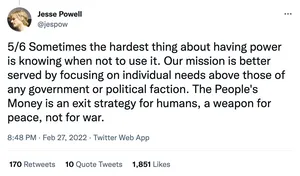
Ukrainian Vice President Mykhailo Fedorov publicly requested major cryptocurrency exchanges to freeze addresses of all Russian and Belarusian users, to increase economic pressure on Russia to end its attacks on Ukraine. Several crypto exchanges including Binance, Kraken, and KuCoin publicly refused to do so. CEO and co-founder of the U.S.-based Kraken Exchange, Jesse Powell, wrote a Twitter thread in which he stated that Bitcoin was "the embodiment of libertarian values" and supposed to be "a weapon for peace, not for war".
Although perhaps unsurprising that these exchanges refused a request like Fedorov's, it will be interesting to see if and how sanctions may affect various cryptocurrency exchanges' actions. Binance, the largest crypto exchange, has already indicated it will comply with sanctions. Kraken, whose executives have tended towards more ideological stances, has also indicated that it will comply with legal requirements to freeze accounts.
Gavin Wood decides war in Ukraine is a great opportunity to promote his Polkadot project
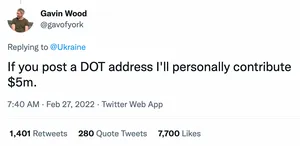
On February 26, the Ukrainian government tweeted Bitcoin and Ethereum addresses, allowing cryptocurrency donations directly to the government to support their resistance to the ongoing Russian invasion. Gavin Wood, a co-founder of Ethereum who is now primarily involved with the Polkadot cryptocurrency network, apparently thought this could be a great marketing opportunity for Polkadot if the Ukrainian government would list a Polkadot address alongside BTC and ETH. He took to Twitter to offer a generous donation contingent on them doing so: "If you post a DOT address I'll personally contribute $5m". I'm sure the Ukrainian government have nothing more important to do than futz around with making wallets for every millionaire who wants to promote his crypto project.
Some with a more optimistic view of Wood's tweet suggested that perhaps his request was motivated by a desire to avoid capital gains taxes that could be incurred by converting his DOT to ETH before donating it, but another commenter pointed out that 1) Wood almost certainly holds more than $5M in ETH already as a co-founder of the project, and 2) Wood lives in Switzerland, where private individuals are generally exempt from capital gains taxes.
Crypto and NFT scammers take advantage of the invasion of Ukraine to boost their grifts
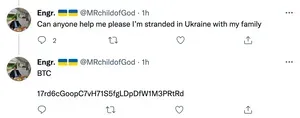
Cryptocurrency scammers have turned to the crisis in Ukraine to provide fodder for their scams. Some have taken the tactic of pretending to be a person trying to escape the country and asking people via private message to send cryptocurrency; others have set up sketchy crowdfunding projects that claim they will send the money to various Ukrainian causes. One scam project tried to get people to buy "UkraineToken", with vague promises of "regular donations and support".
Ukraine-themed NFT projects have also sprung up all over the place, promising to donate portions of proceeds, with very few avenues to distinguish the legitimate from the scams. Some existing NFT projects have created Ukraine-themed items to add to their collections. Other NFT projects that have nothing to do with Ukraine have tried to tempt buyers by claiming they will donate a portion of proceeds (5%, in one case) to Ukrainian war relief funds. Individual sellers have also tried to use the crisis to increase the sales of NFTs they own, promising to donate their profits.
Needless to say, my advice if you're hoping to donate to relief would be to skip the cryptocurrency and NFTs altogether and pick any of the many verified relief funds out there.